Attention EEAY members and others (join us!):
Show your support for EE in the Yukon!
Environmental Education Association of the Yukon
will be holding its
annual general meeting
and sharing session
in honour of
Earth Day
Tuesday April 22
7 pm Whitehorse Public Library
for more info call (867) 633-6456
Apr 10, 2008
educational module for children and teachers on biodiversity and agriculture
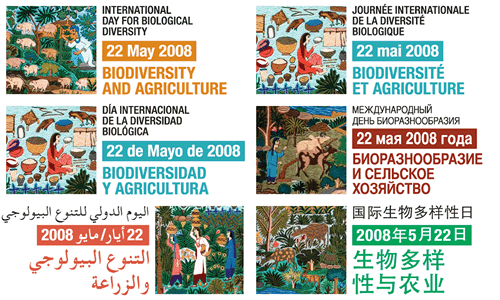 Teaching students about biodiversity, or the variety of life on Earth, is a daunting yet exciting task. The Convention on Biological Diversity (CBD) wants to support teachers in guiding students through a fascinating and exciting exploration of biodiversity issues.
Please accept, Madam/Sir, the assurances of my highest consideration.
Executive Secretary
Secretariat of the Convention on Biological Diversity
United Nations Environment Programme
H2Y 1N9
Tel: +1 514 288 2220
Fax: +1 514 288 6588
E-mail: secretariat@cbd.int
Web: http://www.cbd.int

Environmental Education Online Courses
Online Course Website: http://www.uwsp.edu/natres/eetap/index.aspx
Education Online Courses offered through the
Applied Environmental Education Program Evaluation
This 13-week on-line course is designed to assist environmental educators and natural resource professionals in evaluating their education programs. Participants have the opportunity to develop and apply skills in designing evaluation tools such as surveys, observation forms, and interview and focus group guides. This course was developed as a cooperative effort between the Environmental Education and Training Partnership (EETAP) at the University of Wisconsin-Stevens Point and the U.S. Fish and Wildlife Service (FWS)
“I loved the way the course content was laid out. The units and course content flowed together very well. The course also provided me with ways to test/assess our programs and show results, conclusions, and recommendations in a legitimate way.” – Fall 2004 AEEPE course participant
To learn more, visit the course web site: http://www.uwsp.edu/natres/eetap/index.aspx or contact Angela Lemar (Angela.Lemar@uwsp.edu) for a registration form.
To learn more about EETAP visit the EETAP website at http://www.eetap.org/
Summer 2008 course dates: June 2 – August 22
Fall 2008 course dates: September 8 – December 5
Fundamentals of Environmental Education
A 12-week online course about the fundamentals of environmental education is appropriate for both classroom teachers and for non-formal educators who work with students and/or teachers. Participants may obtain three undergraduate or graduate credits from the University of Wisconsin-Stevens Point. All students, regardless of location, are eligible for the in-state tuition rate. The course is also offered at a reduced cost for those who are not interested in obtaining college credit.
The "Fundamentals of Environmental Education" online course was developed by the Environmental Education and Training Partnership (EETAP) in collaboration with national EE experts. It provides educators with the knowledge and skills necessary to incorporate quality environmental education into their instruction. Participants discuss the history, definition, and goals of environmental education; develop an understanding of the professional roles and instructional methods of environmental educators; and interact with other educators from across the country. Past course participants have given the course excellent reviews.
“This is a remarkable course. It is very well organized and in a way that I find models teaching organization we can all strive for. I enjoyed the opportunity to read about other people's experiences and to benefit from their knowledge and experiences. I also enjoyed reading the helpful comments the instructor gave me and others on the discussion board. What a wonderful opportunity!” – Spring 2005 FEE course participant
To learn more, visit the course web site: http://www.uwsp.edu/natres/eetap/index.aspx or contact Angela Lemar (Angela.Lemar@uwsp.edu) for a registration form.
To learn more about EETAP visit the EETAP website at http://www.eetap.org/
Summer 2008 course dates: June 2 – August 15
Fall 2008 course dates: September 8 – November 28
Leadership Development Natural Resources: Strategic Planning and Implementation
Learn how to develop successful strategic planning and implementation models, processes and techniques. Emphasis will be placed on managing the strategic planning process to build the capacity of organizations to provide effective environmental education programs. Course participants will also have an opportunity for individual consultation time with the course instructor to discuss specific issues/questions they might have regarding strategic planning. This course has been designed for environmental educators, natural resource professionals and graduate students who are currently involved in a strategic planning process or may become involved in one in the future. This is a 9-week course available for 2 graduate level credits through the University of Wisconsin-Stevens Point. It is also available as a non-credit workshop.
“Strategic planning is often misunderstood, misplaced and sometimes forgotten. So this course focuses on best practices for a successful process and its implementation.” - Dr. Corky McReynolds, Strategic Planning and Implementation course instructor
To learn more, visit the course web site: http://www.uwsp.edu/natres/eetap/index.aspx or contact Angela Lemar (Angela.Lemar@uwsp.edu) for a registration form.
To learn more about EETAP visit the EETAP website at http://www.eetap.org/
Fall 2008 course dates: September 22 – November 21
NEW COURSE!!
Making EE Relevant for Culturally Diverse Audiences
This 10-week on-line course is designed to provide participants with the basic knowledge and skills needed to make EE relevant to culturally diverse audiences. Through this course participants will broaden their perspective of EE to encompass interests and issues of concern to culturally diverse audiences, assess barriers to participation among these audiences, and apply cultural competency skills in building relationships and partnerships with members of an audience they intend to work with in the future. Environmental educators must understand how to work with and involve diverse populations to ensure that their perspectives are heard and that they participate fully in environmental decisions being made at the local, regional, and national levels. This online course has been developed in collaboration with national EE experts who represent diverse cultural and ethnic backgrounds. Although there are no prerequisites for this course, a working understanding of environmental education is essential for success in this course. Participants may obtain one undergraduate or graduate credit from the University of Wisconsin-Stevens Point. It is also available as a non-credit workshop for those that are not seeking college credit. All participants, regardless of location, are eligible for the in-state tuition rate.
To learn more, visit the course web site: http://www.uwsp.edu/natres/eetap/index.aspx or contact Angela Lemar (Angela.Lemar@uwsp.edu) for a registration form.
Fall 2008 course dates: September 2 - November 6
Apr 4, 2008
Summer Seminars in Denali Park
| ||||||||||||||
| ||||||||||||||


Apr 2, 2008
Summer Course for K-12 Teachers Understanding the Role of Permafrost in a Rapidly Warming Climate 25-27 June 2008
Summer Course for K-12 Teachers Understanding the Role of Permafrost in a Rapidly Warming Climate 25-27 June 2008
University of Alaska Fairbanks
For further information, please go to: http://www.nicop.org/courses.html http://denali.iarc.uaf.edu/~saito/public/files/08_summer_school/summer_cours
e_2.pdf
or contact: Tohru Saito
E-mail: saito@iarc.uaf.edu
--------------------
"Understanding the Role of Permafrost in a Rapidly Warming Climate" is a one-credit course developed especially for K-12 teachers being offered on 25-27 June 2008, at the University of Alaska Fairbanks in association with the Ninth International Conference on Permafrost.
The purpose of the course is to familiarize elementary and high school teachers with the complex story of how the warming climate will impact Alaskan society, ecology, and hydrology through degradation of permafrost. The course will include local field trips around the Fairbanks area to observe and photograph evidence of permafrost degradation and its original formation during the last glaciation. Attendees will participate in field measurements of permafrost thermal and hydrological variables to quantitatively document the interdependence among the dynamic thermal and hydrological processes. The emphasis will be upon simple measurements and observations that may be conducted by students to better understand the Alaskan environment.
Participants may earn one credit by registering with University of Alaska Fairbanks Summer Sessions (http://www.uaf.edu/summer/). The cost is expected to be $60 USD. Each morning will be spent in an informal classroom-style setting where participants will discuss the relationships and controls among climate, permafrost, and hydrology. There will be two afternoon field trips where participants will visit sites to actively engage in field process studies.
For more information, please contact:
Tohru Saito
E-mail: saito@iarc.uaf.edu
Subscribe to:
Posts (Atom)